
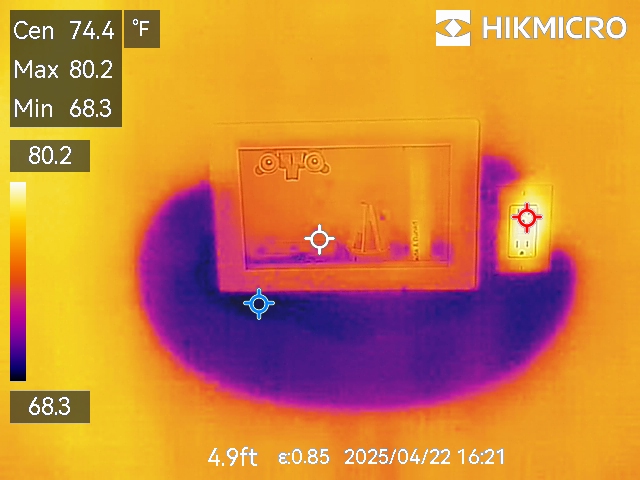
Detect Moisture, Heat Loss & Hidden Issues
Identify problems that aren’t visible to the naked eye. Using certified thermal imaging technology, I can detect hidden issues in electrical, mechanical, and building systems—all without disrupting your home or property. Infrared inspections are included with all residential inspections, giving you extra confidence in your investment.
Identify areas of the home that are missing insulation, moisture problems, or energy loss. You cannot see behind your walls and neither can I. With thermal imaging I am able to identify problems that you may not have known was there. See moisture problems that you did not know was there or why one room feels warmer/cooler than others.
Non-Invasive – No disruption to your home or systems.
Fast & Efficient – Quickly covers large areas while capturing detailed thermal data.
Certified & Experienced – InterNACHI-certified infrared inspector with expertise in interpreting thermal images.
Cost-Effective – Early detection saves money on repairs, energy bills, and future downtime.
All areas of the home are scanned as well as major systems to identify small problems before they become bigger problems. Save on costly repairs.
Identify overheating components, faulty wiring, or loose connections before they become safety hazards.
Detect wear and tear in motors, bearings, and other mechanical systems.
Locate moisture intrusion, insulation gaps, air leaks, and hidden water damage in roofs, walls, and foundations.
Spot potential problems early to prevent costly repairs and equipment failures.
Assess thermal losses to uncover opportunities for improved energy savings and comfort.
This is the most common myth. The camera cannot see through solid objects like a spy gadget. Instead, it captures surface temperature differences.
How it works: If there is a cold spot on a wall, it might indicate missing insulation or a hidden water leak. If there is a hot spot on an electrical panel, it indicates an overloaded circuit. The camera sees the effect of what’s happening behind the wall, not the objects themselves.
An infrared scan excels at finding four specific "invisible" problems:
-Moisture Intrusion: Wet drywall or insulation is usually cooler than the surrounding dry material due to evaporation.
-Electrical Hotspots: It can identify "hot" breakers or loose wiring that are fire hazards before they actually fail.
-Heat Loss/Air Leaks: It pinpoints exactly where your expensive AC or heat is escaping around windows, doors, or attic hatches.
-Pest Infestations: Large nests of wood-destroying insects (like bees or termites) generate metabolic heat, which can sometimes show up as a "glow" behind a wall.
Not necessarily. Thermal imaging is a powerful tool, but it has limitations. For example, if a leak is currently bone-dry because it hasn't rained in weeks, the camera won't detect it. For the best results, we need a temperature differential (Delta-T) between the inside and outside of the house.
Most inspectors offer this as either an "add-on" or a standalone service: Wittner inspection Services, LLC offers this totally FREE with a standard residential inspection!
-Value Tip: Identifying just one missing patch of insulation or a single slow leak can often pay for the cost of the inspection ten times over in avoided repair bills.
To get the most accurate "thermal map" of your home, we recommend:
-Closing all windows and doors at least 4 hours before the inspection.
-Moving large furniture (like sofas or beds) away from exterior walls, as these can mask temperature signatures.
-Running the HVAC: Setting the AC or heat to create a significant temperature difference between the indoors and outdoors helps anomalies "pop" on the camera.
You won't just get a list of text. Your report will include side-by-side comparisons:
-A Standard Photo: To show you exactly where in the room the issue is located.
-The Thermal Image: To show the heat/cold signature of the defect.
-Temperature Data: The specific degrees detected, which helps determine the severity of the problem.
Actually, we find defects in new construction all the time. Common "new home" issues include insulation that was never installed in certain wall cavities, or HVAC ducts that were improperly connected and are blowing cold air into the attic instead of the living room.
Infrared inspections provide peace of mind by revealing hidden problems before they become costly failures. Whether you’re maintaining your home, preparing to sell, or improving energy efficiency, I give you the insights you need to protect your investment
lorem ipsum Quam est faucibus porttitor luctus sem phasellus. Pretium neque aliquet .
